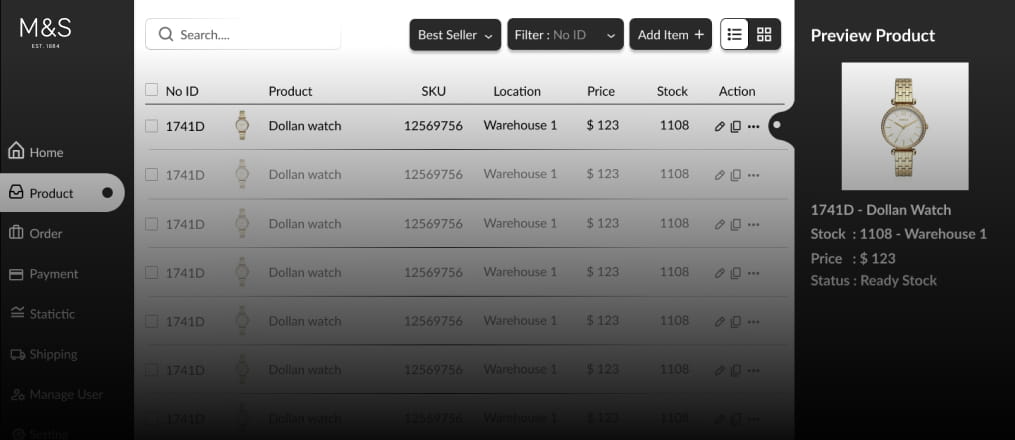

Disconnected Data Sources
Disconnected sources of data across IRP, green stock, invoices, development sheets, and vendor deliveries
 FMCG / Human Resources

Marks & Spencer (M&S) is one of the United Kingdom’s most iconic retail brands, renowned for its premium clothing, home, and food offerings. With a legacy spanning over a century, M&S operates across multiple global markets and serves millions of customers through its physical stores and digital platforms. The company places strong emphasis on innovation, operational excellence, and customer-centric merchandising to stay ahead in the highly competitive retail landscape.

Create a digitized, version-controlled foundation for product information

Ensure consistent and accurate product data across teams through a unified platform

Enable real-time updates and streamlined collaboration

Minimize manual effort while strengthening data accuracy and enabling automated reporting
Disconnected sources of data across IRP, green stock, invoices, development sheets, and vendor deliveries
Lack of version control and audit history to track who made what change and when
Risk of duplicate processing due to absence of change detection or file-level checks
Inability to enforce structured workflows such as pricing approvals and departmental sign-offs
Slow turnaround on catalog updates and poor visibility into real-time product readiness
High dependency on a few individuals to interpret and validate catalog entries manually
Disconnected sources of data across IRP, green stock, invoices, development sheets, and vendor deliveries
Lack of version control and audit history to track who made what change and when
Risk of duplicate processing due to absence of change detection or file-level checks
Inability to enforce structured workflows such as pricing approvals and departmental sign-offs
Slow turnaround on catalog updates and poor visibility into real-time product readiness
High dependency on a few individuals to interpret and validate catalog entries manually
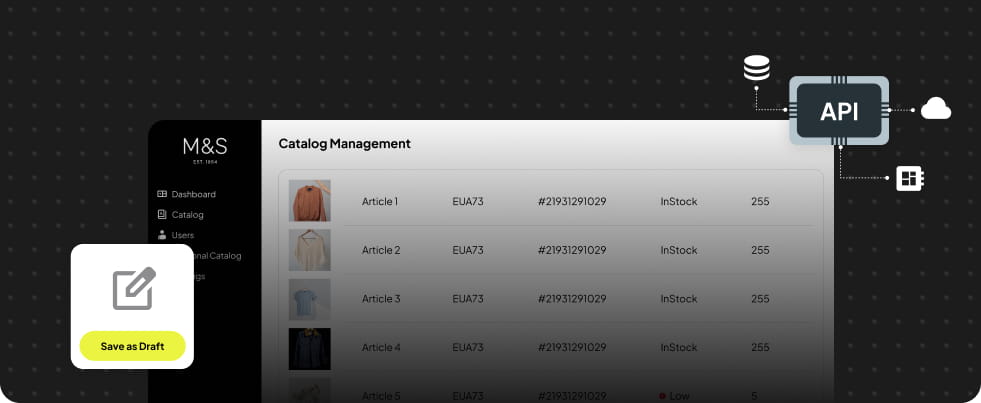
Catalogs are generated by season and department with user-managed dynamic columns that extend as business needs evolve. The system supports multi-source file templates and API integrations, allowing users to save progress as drafts or commit validated data to the live catalog.
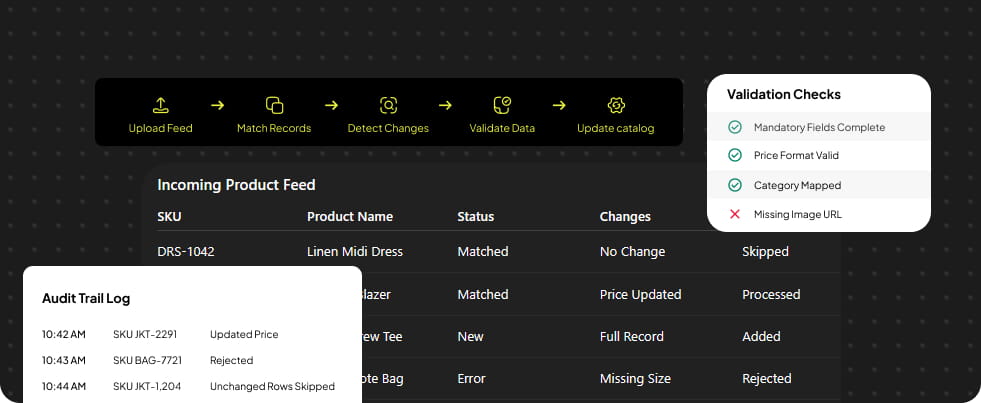
The backend engine automatically detects data matches, skipping duplicate or unchanged records to optimize performance. A rigorous validation layer checks formats and mandatory fields, rejecting unclean data while maintaining detailed logs for audit trails.
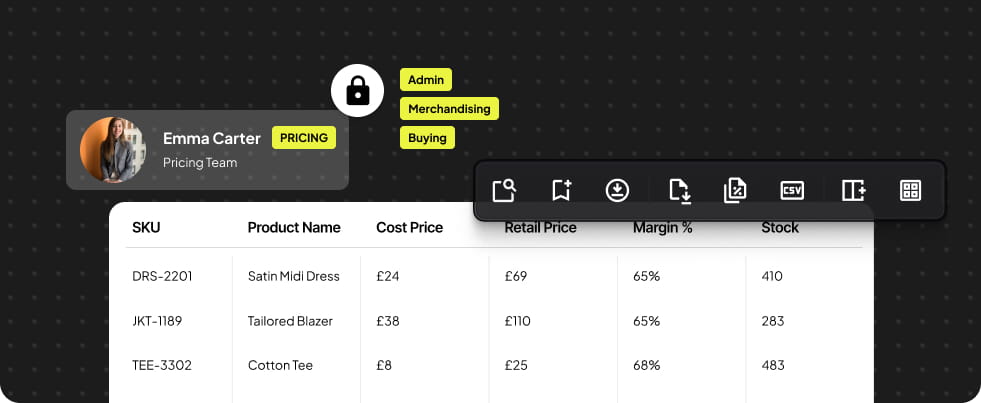
Access is managed at the column level, ensuring specific teams like Pricing or SCM only edit fields relevant to their functions. The web-based interface is optimized for high-speed data entry, supporting both native Excel updates and keyboard-driven navigation to maximize efficiency.
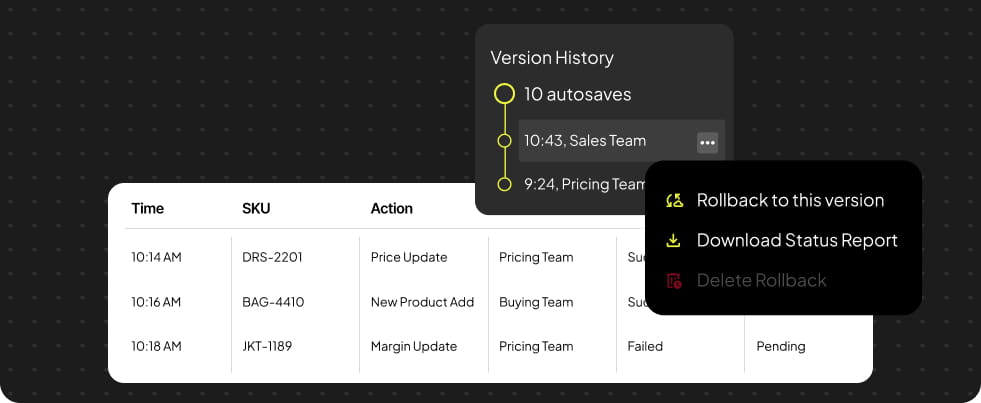
Every row-level change is captured with success/failure status and rollback traces to ensure total accountability. Detailed error reporting provides downloadable logs for failed uploads, making it simple for teams to identify, fix, and reprocess data inconsistencies.
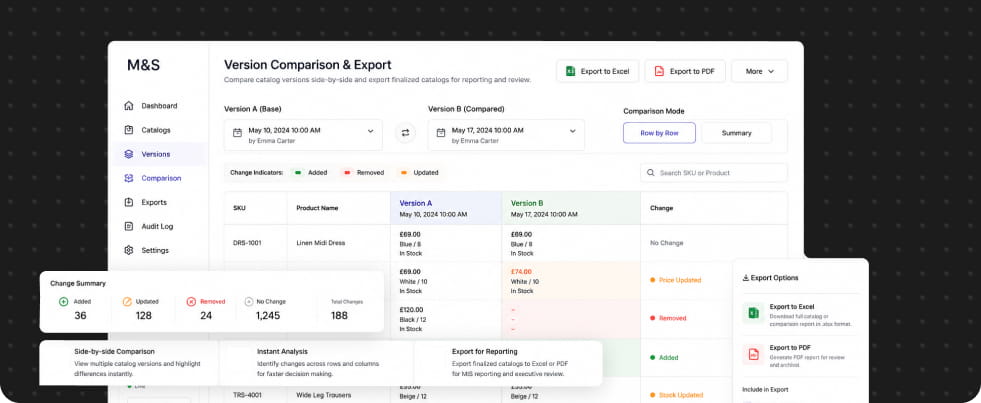
Built-in tools enable side-by-side comparison of multiple catalog versions, highlighting differences across rows and columns for instant analysis. Finalized catalogs can be exported as PDFs or Excel files for offline archival, MIS reporting, and executive review.
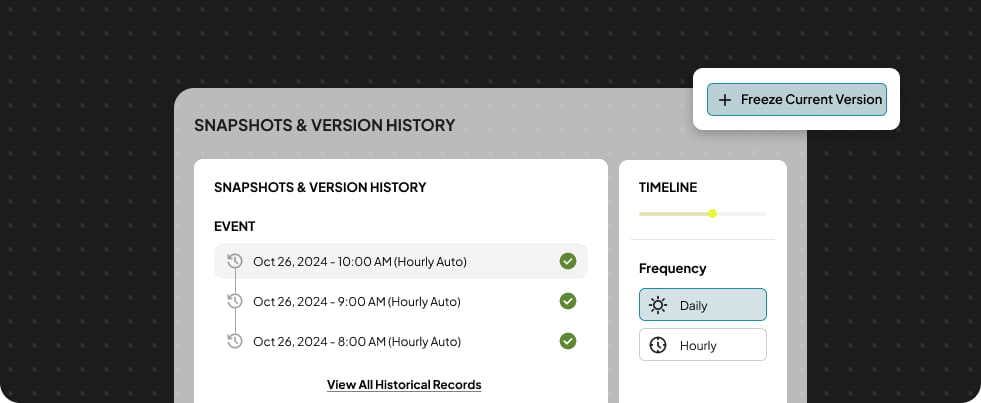
Snapshots are auto-generated on a daily or hourly basis to preserve a complete historical record of the catalog. Users can manually freeze specific versions by providing reason codes, which the system logs alongside timestamps and user IDs for clear tracking.
Catalogs are generated by season and department with user-managed dynamic columns that extend as business needs evolve. The system supports multi-source file templates and API integrations, allowing users to save progress as drafts or commit validated data to the live catalog.
The backend engine automatically detects data matches, skipping duplicate or unchanged records to optimize performance. A rigorous validation layer checks formats and mandatory fields, rejecting unclean data while maintaining detailed logs for audit trails.
Access is managed at the column level, ensuring specific teams like Pricing or SCM only edit fields relevant to their functions. The web-based interface is optimized for high-speed data entry, supporting both native Excel updates and keyboard-driven navigation to maximize efficiency.
Every row-level change is captured with success/failure status and rollback traces to ensure total accountability. Detailed error reporting provides downloadable logs for failed uploads, making it simple for teams to identify, fix, and reprocess data inconsistencies.
Built-in tools enable side-by-side comparison of multiple catalog versions, highlighting differences across rows and columns for instant analysis. Finalized catalogs can be exported as PDFs or Excel files for offline archival, MIS reporting, and executive review.
Snapshots are auto-generated on a daily or hourly basis to preserve a complete historical record of the catalog. Users can manually freeze specific versions by providing reason codes, which the system logs alongside timestamps and user IDs for clear tracking.
We proposed and designed a pluggable rules engine which was built for future deployment of anomaly detection, data scoring, and field completion intelligence.
Minor format errors like column shifts or header misalignment are automatically corrected with user alerts and smart prompts. This reduces rejection rates and enhances the experience for business users.
An admin dashboard displays KPIs like % completion, failed rows, pending approvals, and upload history — improving leadership visibility and governance
The platform was designed and architected to expose catalog data via secure APIs in future phases for seamless integration with SAP, Power BI, and allocation tools.




Catalog update cycle reduced by 45% through automation and validations
Manual error rate reduced significantly, with nearly 30–40% fewer corrections needed post finalization
Reduced back-and-forth between UK and India teams by ~60% due to live web-based collaboration
Enabled consistent reporting output used by MIS without last-minute data corrections
Improved transparency and audit readiness through auto-versioning and logs
Through this catalog digitization initiative, M&S streamlined seasonal data operations—reducing manual effort and enabling a secure, structured workflow. The platform creates a scalable foundation for future growth while supporting AI, automation, and analytics, improving productivity and data accuracy.

FinThrive is a leading Revenue Cycle Management (RCM) solution provider in the U.S. healthcare sector, offering cutting-edge, AI-powered services across claims processing, patient access, and revenue recovery. It helps healthcare organizations increase revenue, reduce costs, expand cash collections, enhance patient financial experience and ensure regulatory compliance with advanced, scalable technology.
Read Case Study arrow_right_alt
KFC is one of the world’s most recognized quick-service restaurant brands, known for delivering quality food experiences across global markets. For its Dubai operations, the focus was on strengthening data-driven decision-making through smarter reporting and operational visibility. To support this, a tailored Power BI solution was implemented to transform complex business data into clear visual […]
Read Case Study arrow_right_alt
Marks & Spencer (M&S) is one of the United Kingdom’s most iconic retail brands, renowned for its premium clothing, home, and food offerings. With a legacy spanning over a century, M&S operates across multiple global markets and serves millions of customers through its physical stores and digital platforms. The company places strong emphasis on innovation, […]
Read Case Study arrow_right_alt
Vastian is the leading provider of healthcare and laboratory quality, compliance, and accreditation solutions, powering laboratories and hospitals to achieve better clarity and show their higher standards. Our single, configurable integrated platform delivers a standardized, centralized solution that automates quality and compliance tasks and is fully customizable. With Vastian, health systems and labs can get […]
Read Case Study arrow_right_alt
L’Oréal is one of the world’s leading beauty brands, recognized for its extensive portfolio across skincare, haircare, makeup, and professional beauty products. With a large global workforce and operations spanning multiple regions, the company places strong emphasis on innovation, people development, and data-driven decision-making. To strengthen workforce visibility and strategic HR planning, L’Oréal sought a […]
Read Case Study arrow_right_alt