Offshore Software Development Trends: 5 Key Trends to Watch

Businesses want to produce high-quality products while keeping costs down. How can it be done? Through offshore software development. The popularity of this approach stems from its ability to find skilled talent worldwide. The cost-effectiveness of this model further makes it a favourite of everyone.
However, the global IT landscape is ever-evolving. The changes affect the offshore development sector as well. To make the most out of it, you must know the recent and future trends. In this blog, we will review 5 trends shaping this field.
1. Widespread Adoption of Agile and DevOps Practices
The demand for quick delivery of software has increased the adoption of Agile and DevOps approaches. These approaches promote teamwork in offshore development. They also support continuous integration and iterative development. This, in turn, enables teams to deliver quality products efficiently.
In the coming five years, the adoption of these approaches will become all-pervasive. As a result, offshore teams will benefit from smooth integration. It will also increase the chances of project success.
Agile seeks speed. DevOps emphasizes efficiency and accuracy. Deploying both can help businesses scale up quickly with fast product delivery.
The factors below help ensure agile delivery with a DevOps approach.
- Product-oriented teams, as they are in it for the long run in comparison to project-oriented teams. Their vision is broad. They aim for the continued success of the software.
- A microservices architecture allows for agile delivery. It also DevOps culture
- Automated governance is essential across various points throughout the SDLC. It increases the chances of successful implementation of agile and DevOps.
- Enhance the SDLC by frequently measuring the success of a DevOps plus agile approach
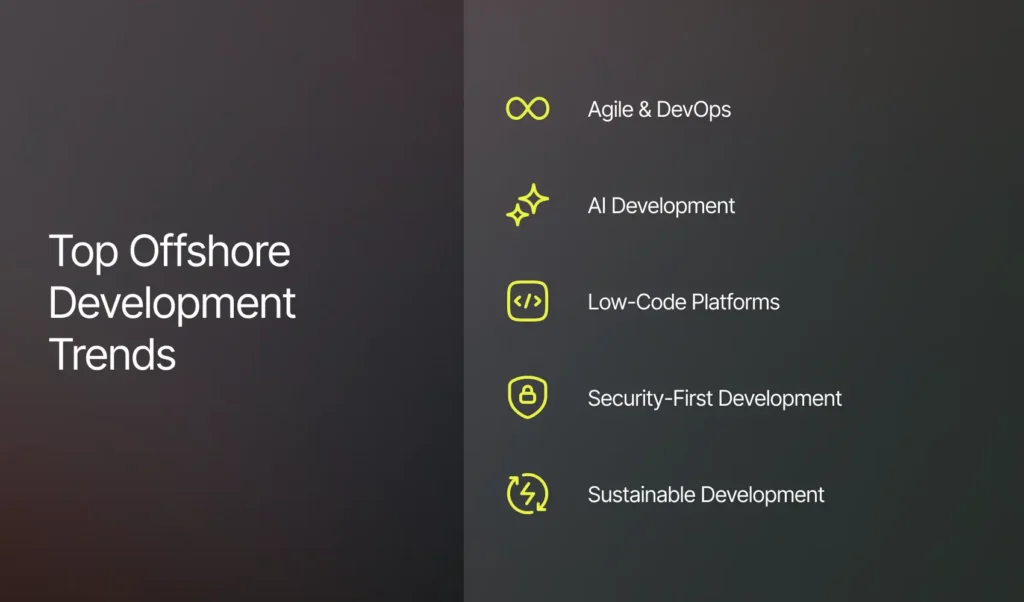
2. AI-Led Software Development
AI is changing offshore software development in many ways. AI tools are automating what was once solely dependent on human creativity. These programs help offshore developers work more quickly and better. They boost their productivity and the code quality.
Below are the various tasks that AI helps with:
Automation Of Coding Tasks
With AI, routine work like migrations, code generation, and test executions can be delegated to advanced systems. This allows the offshore teams to focus on the vital aspects of the development life cycle. Thus, it increases overall productivity and innovation.
Code Quality Optimizations
AI can help developers assess errors. It enables them to spot gaps that were missed in software development. This can substantially improve the total quality and code reliability. It saves much time for the entire organisation. It can also lead to spotting issues before the code goes live.
Code Generation
AI automates the code review process. AI tools can swiftly spot potential issues. Then, they recommend improvements and deliver precious insights. This, in turn, allows an offshore software development company to focus on more mission-critical tasks. At the same time, it ensures the maintenance of high-quality code during SDLC.
Code Refactoring
AI can help nearshore developers refactor their code to make it readable and maintainable. These tools can also give developers knowledge of the security implications. They also indicate the vulnerabilities of their code. All of it helps ensure the code is safe and backwards-compatible with legacy systems. It also ensures that the code is in line with the best industry standards.
Code Reviewing
Now, offshore developers can automate parts of the code review process with AI. They can recommend changes and discover possible issues. AI-led code reviewing dramatically saves developers’ time. It lets them write quality code throughout the development process.
Testing and Debugging
AI tools can have massively impacted testing and debugging workflows. They can automate test case generation. The tools can also create boilerplate test code and assess test results. This greatly lowers the overall time spent to spot and fix issues.
3. Low-Code and No-Code Platforms
Low-code and no-code platforms allow users to build apps with pre-built components. They can then connect them via a visual interface. Increasingly, offshore software development teams globally are adopting these platforms. The market for these systems is set to touch $65 billion by 2027. This growth stems from the following factors:
- Swift Digital Transformation: Businesses today face greater pressure to modernize processes and meet client needs swiftly. Low-code and no-code tools enable quick development to fulfil these demands.
- Higher Demand for Agility: Organizations need to pivot quickly in response to evolving market conditions. These platforms enable them to adapt without heavy resource usage.
- Developer Talent Shortages: Globally, there’s a shortage of skilled developers. So, businesses are turning to platforms that empower non-technical employees to assist in application development.
Benefits of Low-Code and No-Code Platforms
The growing popularity of these systems comes from their advantages, as explained below:
- Swift Time-to-Market: Programs can be built and deployed up to 90% faster compared to conventional methods.
- Cost Efficiency: Less reliance on big development teams and streamlined workflows cuts operational expenses.
- Better Collaboration: These tools foster better alignment between IT and business teams. Thus, they ensure shared goals and outcomes.
- Scalability: Enterprise-grade tools available on various platforms allow businesses to grow without beginning from scratch.
Planning to Build with an Offshore Team?
4. Security-First Offshore Software Development
Offshore teams placing security experts into their workflows is not an isolated trend. It’s an industry-wide shift. More companies are recognizing that traditional cost-driven offshoring models cannot prevent the huge scale of digital threats. There is a surge in ransomware, phishing, and supply chain attacks, along with regulatory changes, such as the 2025 U.S. Coast Guard Cybersecurity Rule for critical infrastructure. It’s a key driver behind organisations building specialised security roles within their global teams. Simultaneously, they are looking for offshore software development providers with demonstrated sophistication in managing cyber risks.
The Global Cybersecurity Outlook 2025 report states that just 14% of organizations have the required talent. In turn, it’s making businesses, both big and small, reliant on offshore software development expertise. The teams provide around-the-clock incident response, threat monitoring, and compliance management to ensure prevention and detection of threats on and before time.
How Offshore Software Development Teams Address Security Concerns?
Offshore software development firms use a wide variety of measures to fix security concerns, such as:
- Data protection mechanisms, like data encryption, access controls, penetration testing, and vulnerability analysis
- Adherence to global security protocols (HIPAA and GDPR)
- Continuous monitoring and auditing of SDLC
- Proper communication throughout the project’s length
- Non-disclosure agreements to make intellectual property and proprietary data safe
5. Greater Focus on Sustainability
Sustainable development for software that consumes less energy is a major trend gaining ground. Autoscaling technology and green data centres are two widely used examples that highlight this trend. In fact, the green data centre market is about to hit $155.75 billion by 2030!
Offshore development experts are integrating sustainability into their business practices in many ways. The major ones include:
- Green coding practices for reduced energy consumption. These focus on eliminating repetitive processes in coding and energy optimization when choosing data structures.
- Choosing data centres that use renewable energy (wind, solar, and hydroelectric power)
- Measuring the environmental impact of the software. It is done through metrics like energy consumption, carbon emission, and resource utilization rates.
Besides sustainability, businesses and offshore developers are looking at the social impact of their operations. It is especially evident in employee welfare and community involvement:
Fair Labor Practices
Many offshore software development firms are working on fair wages, safe working conditions, and equal opportunities for their workforce. Modern firms are adopting transparent “cost-plus” pricing models. In it, their clients understand exactly what the firm’s developers earn and what service fees take care of. This transparency builds trust.
Within local markets, senior developers earn $55-85/hour in Eastern Europe. In Latin America, the rate is $50-85/hour. These figures are competitive with local standards.
Diversity and Inclusion
Offshore companies are also emphasising diverse teams. This means building a culture of inclusiveness. Professionals from various backgrounds, genders, and ethnicities collaborate. Diversity affects employee satisfaction positively and also leads to more innovative solutions.
Summing Up
The best way to leverage them is to partner with an offshore software development company. At Imenso Software, we have a growing portfolio of projects across industries. We can help you hire dedicated offshore development teams that follow industry best practices to create innovative solutions. Whether you want to build your product from scratch or need a simple MVP, we are eager to help. Contact us today.