Detailed Guide to Implementing Business Intelligence in Healthcare
Effective use of data in healthcare optimizes patient outcomes. It’s exactly here that healthcare business intelligence makes its mark. It enhances the care quality and clinical flows. Data management with BI enables hospitals with data-led decision-making. Ultimately, it gives every party involved a satisfying experience.
In this blog post, we will go into detail about implementing BI in healthcare. We will talk about its use cases in medical settings. Further, we will provide you with a detailed breakdown of how to implement BI in a clinical environment. By the end of it, you will be better positioned to develop an efficient BI strategy for your medical facility.
What is Healthcare Business Intelligence (BI)?
Business Intelligence is a specific set of technologies, workflows, and tools. They allow companies to collect, store, and assess data to inform business operations. It turns raw data into insights. Thus, it helps with creating better care strategies. It also anticipates future trends. BI-made visualizations and data analytics show data in an easy-to-grasp way. Thus, it lets organizations drive better outcomes.
In healthcare, BI plays a vital role. Healthcare Business Intelligence refers to the application of BI tools to health-related data. The healthcare domain brims with ginormous data. But it’s of no use until it is deciphered.
What Accounts for the Rise of Healthcare BI?
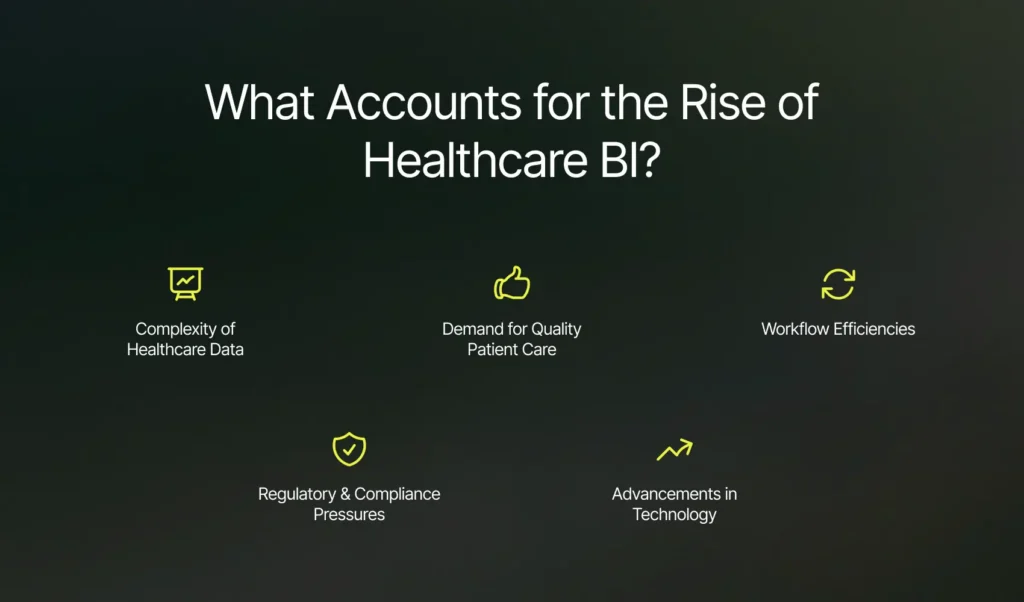
Healthcare BI stems from:
- Complexity of Healthcare Data: Clinical data arises from numerous sources. Data is present in varying formats. So, special programs are needed to make sense of this data.
- Demand for Quality Patient Care: Patient-first interventions have become essential. So, the demand for data-driven approaches to customize therapies is increasing.
- Workflow Efficiencies: Healthcare facilities have tight budgets. They are always seeking means to better their operations. Healthcare BI gives insights into the gaps. It offers pathways to optimize costs and manpower.
- Regulatory and Compliance Pressures: Hospitals have to obey strict regulatory rules. BI tools ensure that facilities stick to these standards. It maintains the integrity of the data.
- Advancements in Technology: Today, next-gen data platforms have emerged. Health institutions are in a good position to tap into the power of BI.
Key Use Cases of BI in Healthcare
BI tools optimize clinical and administrative workflows in all healthcare areas. From patient diagnosis and treatment to clinical trials, they aid with every aspect.
Individual Health Analytics
BI assesses each patient’s data. It discovers relations between services and health outcomes. This leads to better patient care and cuts care costs.
Population Health Management
Analyzing data from various sources allows the spotting of health trends and risk factors. So, it gives opportunities for intervention in a specific group of patients to advance population health.
Staffing Optimization
BI uses hospitals’ data to optimize staffing levels. It helps redistribute the workload and lower burnout rates.
Fraud Detection
Healthcare BI processes data from various sources. This is done to spot and prevent insurance fraud. It reduces resource wastage and care system abuse.
Clinical Trial Management
Tracking and assessing data from clinical trials enhances trial efficiency. It increases participants’ satisfaction. This, in turn, leads to higher accuracy of the trial outcomes.
Quality Reporting and Improvement
BI creates data-based KPI reports. These reports provide essential information, such as the average length of a hospital stay and the number of readmissions. Thus, it becomes easier for facilities to comply with regulations.
Revenue Flow Improvement
Processing financial data to enhance the revenue cycle, including billing and insurance procedures.
Facility Management
BI’s analysis of data from IoT devices and hospital management software to track the safety, hygiene, and proper usage of facilities.
Drug Research
Processing data from healthcare, pharmaceutical, and other sources to create new treatments quickly and effectively.
Planning to Implement BI in Your Healthcare Organization?
Step-by-Step Guide to Implementing BI in Healthcare
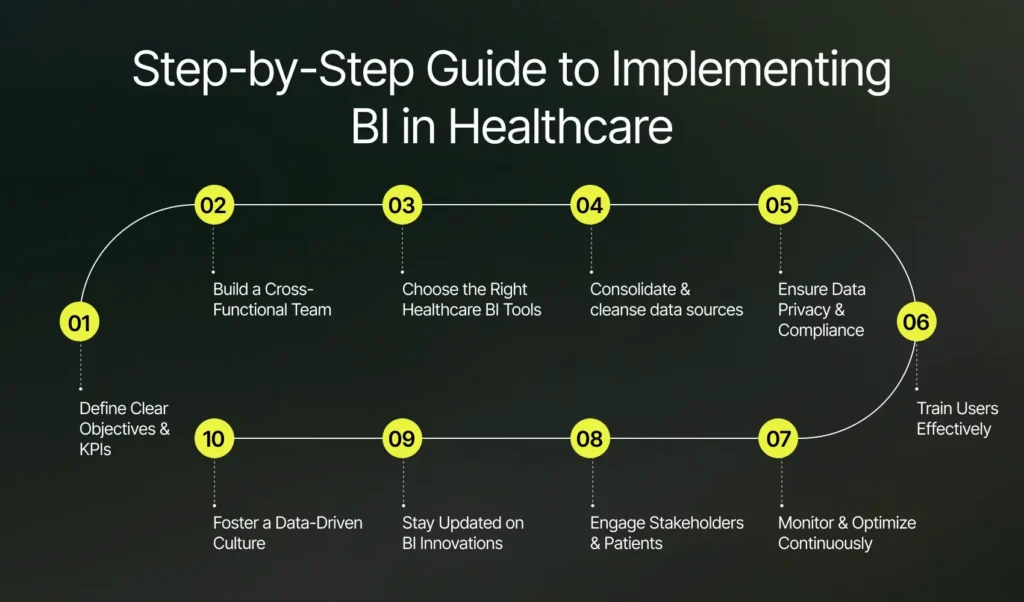
1. Define Clear Objectives & KPIs
Decide what you want with BI in your business. Is it to improve patient outcomes or cut costs? Make goals measurable and set KPIs for them. Revisit these objectives you set after projects or reviews.
2. Build a Cross-Functional Team
A cross-functional team has IT, data analysts, clinicians, and admin staff. They cover all the key perspectives. In this team, everyone should have clear roles. Hold regular, short check-ins to stay aligned.
3. Choose the Right Healthcare BI Tools
Pick BI platforms built for healthcare. Prioritize security, ease of use, and strong analytics. Test tools with real workflows before you invest and find vendors with healthcare experience.
4. Consolidate and cleanse data sources
Bring data from all systems into one place. Make the date free from duplicates and inconsistencies. Document data sources and formats and automate cleansing where possible.
5. Ensure Data Privacy & Compliance
Patient records should be safeguarded at all costs. You must consider laws like HIPAA and use strict access controls. Log access and audits for all data and give training on privacy rules and consequences.
6. Train Users Effectively
Train all users on the tools and reports. They must know how to analyze results and act on insights. The staff should have access to quick reference guides and videos. Offer refresher sessions after updates.
7. Monitor & Optimize Continuously
Review BI performance to improve. Gather feedback and make small, regular updates. Track KPI trends and anomalies. Perform fixes that give you fast value.
8. Engage Stakeholders & Patients
Share relevant findings with staff and patients. Use input to shape actions and build trust. Create simple reports for non-technical audiences. Invite feedback and respond visibly.
9. Stay Updated on BI Innovations
Watch new tools and best practices. Learn from peers and adapt when needed. Subscribe to a few trusted sources to strengthen your knowledge. Pilot promising ideas on a small scale first.
10. Foster a Data-Driven Culture
Make data the basis for decisions. Encourage and reward evidence-based thinking. Highlight wins that came from data use. Lead by example at all management levels.
Harness the Benefits of BI in Healthcare
BI presents a paradigm shift for the medical industry. From improving patient outcomes to improving workflows, it offers countless benefits. With BI tools, hospitals can dig deep into their data and optimize every aspect of their work.
The healthcare landscape is ever-evolving. Every day, the significance of data-driven insights continues to rise. At this time, partnering with experts in the field can make a world of difference. Imenso Software helps healthcare organizations face and solve the challenges of BI implementation. We seamlessly integrate and consolidate data from diverse sources. Our team embeds data security and compliance into every BI service we offer. Talk to us today to get the most out of BI implementation in your healthcare setup.