Cost to Build an E-Commerce App — Complete Breakdown
Are you speculating about the cost of building an e-commerce app in 2025? Well, entrepreneurs do face challenges in developing an e-commerce application. This is more because of their tight budget constraint. Also, unexpected mid-project cost spikes derail the progress. And, your dream project will be only a step away from turning into a worst nightmare!
“There is an app for everything,” you must have heard this phrase. This million-dollar statement is elevated now due to the newest app development trends with raging mobile apps and web apps.
So, you need to constantly innovate in the budget. Here is a step-by-step guide to help you plan your e-commerce app development in 2025.
Why Are E-Commerce Apps Booming in 2025?
The adoption of mobile apps has witnessed a rise after COVID-19. Due to this, customers spend 12% more time than they did in 2021. Also, the global retail e-commerce sales reached an estimated 6 trillion U.S. dollars. This figure is expected to increase by 31%, i.e., about 8 trillion dollars, by 2028.
In fact, fewer people have reservations about spending online. That’s why, number of online shoppers is rising exponentially in the
coming years. Also, there are various other reasons due to which entrepreneurs are now looking forward to actively investing in e-commerce app development.
- Expanding Customer Reach
- Enhanced User Experience
- Higher Conversion Rates
- Brand Loyalty
- Customer Retention
- Insights Driven By Data
- Competitive Benefits
- Scalability and Revenue Growth
- Integration with Emerging technologies
- Cost-Effectiveness Over Time
- Adaptability to Market Trends
But customers are more drawn to the apps that add more value to them.
Types of E-Commerce Apps and How They Affect The Budget
Know this: not all e-commerce apps are built the same. The chosen app type has an impact on the overall development cost, timeline, and complexity.
Let’s break down the five most common types in the market:-
| Description | Pros | Cost Range | Who’s it for | |
| B2C Shopping Apps | These apps are built for businesses selling directly to consumers, for instance, Walmart, Target. |
|
$100,000 to $250,000 | Established brands and traditional retailers |
| Niche DTC Apps | Brands like Allbirds or Gymshark focus on a narrow niche and sell directly through custom mobile apps. |
|
$70,000 to $150,000 | |
| Marketplace Apps | Apps like Etsy, StockX, or Poshmark let users buy and sell within a platform |
|
$150,000 – $300,000+ | Startups building P2P selling platforms or niche marketplaces |
| Subscription-Based Apps | Think BarkBox or Thrive Market, offerring recurring deliveries or memberships. |
|
$80,000 – $200,000 | Businesses with recurring revenue models or consumable goods |
| Social-Commerce-First Apps | It is for community-driven commerce integrated with TikTok, Instagram, or YouTube Shopping. |
|
$100,000 – $250,000+ | Brands targeting Gen Z and creators |
| Quick Tip Start with a basic MVP version and scale based on user feedback, if you are unsure which type fits. This helps avoid rebuild costs later. |
Core Features That Influence E-Commerce App Cost
Your feature list is the single biggest cost driver when it comes to building an e-commerce app. The more features you pack in, the more money is needed to bring your app to life.
Let’s break it down into two parts.
| Description | Features | Estimated cost | |
Essential Features |
This acts as a baseline for any e-commerce features. They are required to launch even a simple MVP: |
|
$25,000 – $50,000 |
Advanced Features |
These features drive growth & retention. Want your app to compete with Amazon, SHEIN, or GOAT? These upgrades are your power tools: |
|
$30,000 – $100,000+ depending on complexity |
| Add-on Integrations | These small plug-ins can add $5,000–$20,000 to your project, depending on API costs and customization. |
|
| Pro Tip Start with just the core shopping flow and use tools like Firebase Remote Config or Feature Flags to unlock upgrades later. This will save you time and cost early on. |
What Shoppers Expect from Your App?
You’ve probably heard the phrase, “People judge a book by its cover.” In e-commerce apps, that cover is your design, and it can make or break your success.
According to Forrester, 38% of users will stop using an app after just one bad experience. U.S. shoppers expect clean, fast, mobile-first interfaces with frictionless navigation and trust-building visuals.
What Goes into E-Commerce App Design?
Design costs cover more than just the look:
- Wireframes: app layout and user flow
- UI design: visual style, colors, buttons, typography
- UX strategy: how easily users navigate, search, buy, and reorder
- Micro-interactions: loading animations, cart confirmations, and much more.
Design Approaches and What They Cost
| Design Approach | Description | Cost Estimate |
| Template-based | Faster, cheaper, but less unique | $3,000 – $7,000 |
| Custom design | Unique brand identity, better UX | $8,000 – $25,000+ |
| UX redesign | For businesses rebranding or re-platforming | $5,000 – $15,000 |
What do Users Expect, Especially Gen Z and Millennials?
- Clean and minimalist designs.
- Fast load times.
- Clear product visuals & reviews.
- Frictionless checkout at Apple Pay, face scan, and autofill.
- Dark mode with ADA accessible design.
Design Tips to Save Budget Without Sacrificing UX:
- Use UI kits, e.g., Shopify Polaris, Material Design
- Choose mobile-first tools like Figma or Framer
- Reuse patterns from successful apps, Amazon, Nike, GOAT
- Prioritize screens by impact as home > product > checkout.
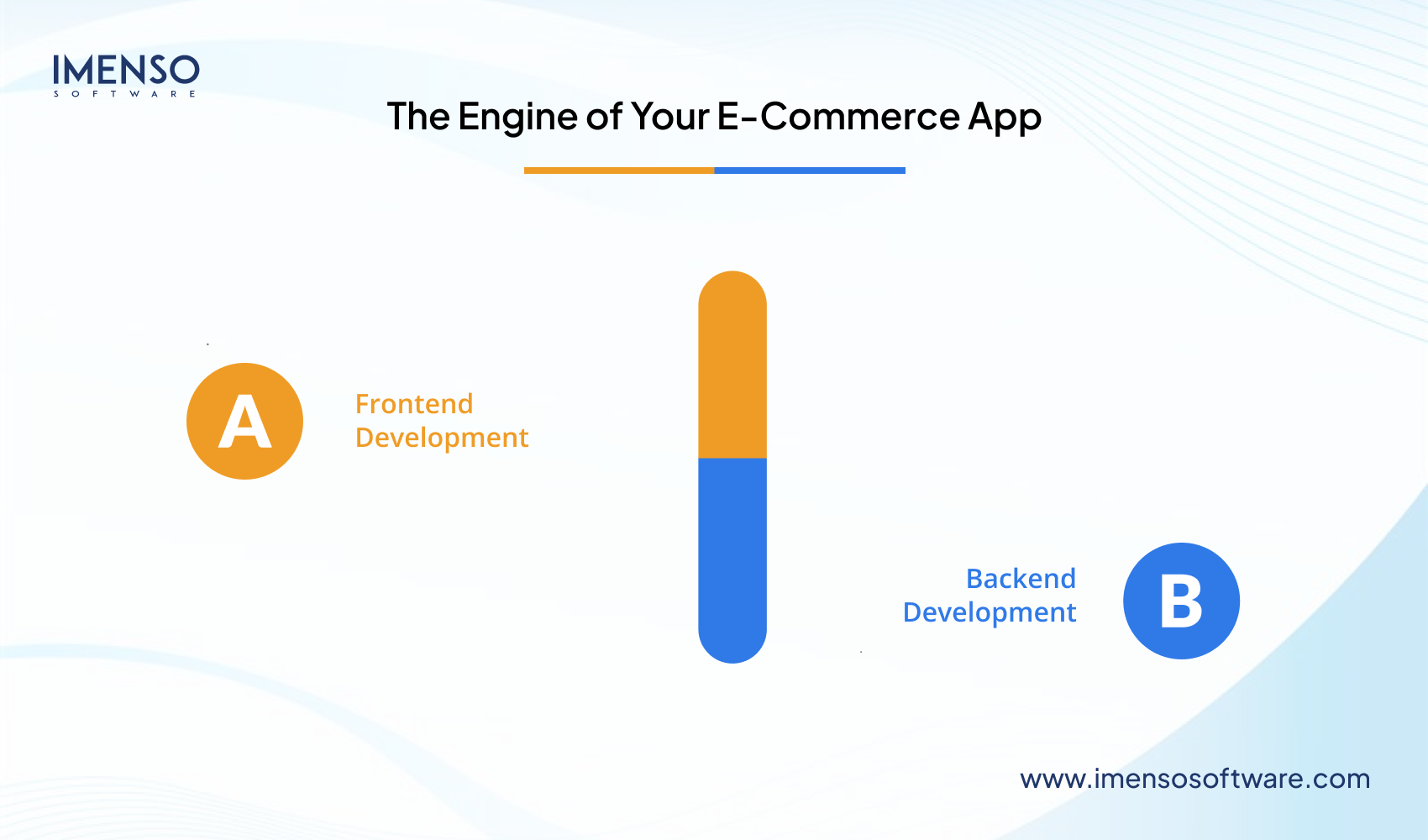
The Engine of Your E-Commerce App
Design might win hearts, but development makes your app work. Think of it like this:
- Frontend means the showroom that users see and interact with.
- Backend means the warehouse and cash register; it is what powers the logic and data behind the scenes.
a. Frontend Development
This includes everything users interact with:
- Navigation menus
- Product pages
- Shopping cart
- Checkouts
- Animations and transitions
Tech Choices:
- Native like Swift for iOS or Kotlin for Android – best performance & higher cost.
- Cross-Platform with Flutter or React Native – faster build, shared codebase, and cost-effective.
- Progressive Web Apps – lightweight & install-free alternative.
The frontend development cost is around $20,000 – $80,000 or more.
b. Backend Development
This is your app’s brain and backbone:
- Manages users, products, and payments
- Stores data securely
- Connects APIs (shipping, payment, email)
- Handles inventory, order tracking, and returns
Popular Tech Stacks:
- Node.js and MongoDB.
- Firebase, is great for MVPs.
- Ruby on Rails or Django for rapid prototyping.
- Headless platforms such as Shopify Hydrogen & Commerce.js.
The backend development costs $25,000 – $100,000 or more, depending on complexity.
The Developer Rates as of 2025:
| Role | Hourly Rate (U.S. |
| Frontend Developer | $80 – $150/hr |
| Backend Developer | $100 – $200/hr |
| Full-Stack Developer | $120 – $180/hr |
Use serverless tools like Firebase or platforms like Shopify with a custom frontend for startups. You’ll get fast backends without the high dev cost of building from scratch. Also, use trusted services like Stripe or Shopify Payments, which are already PCI-DSS compliant. It reduces your compliance headaches—and protects your brand.
Cloud Hosting & API Integration Costs
Do you know building an app is only half the journey? But, keeping it running, secure, and scalable is the other half. That’s where cloud hosting and third-party integrations come in.
These tools help your e-commerce app do everything.
Hosting Options for E-Commerce Apps
Cloud hosting ensures your app loads fast and stays online, also handles traffic spikes, especially during big sale events like Black Friday.
| Hosting Provider | Best For | Monthly Cost Range |
| Firebase | MVPs and startups | $25 – $500 |
| AWS (Amazon) | Scalable, custom backend setups | $100 – $3,000+ |
| Vercel / Netlify | Headless commerce frontends | $20 – $200 |
| Shopify Plus | Turnkey e-commerce hosting | $2,000 – $5,000+ |
Must-Have Third-Party Integrations
To build faster and smarter, most e-commerce apps plug into external tools:
| Tool Category | Example Services | Cost Estimate |
| Payments | Stripe, PayPal, Apple Pay | 2.9% + $0.30 per txn |
| Shipping & Fulfillment | Shippo, EasyPost, ShipStation | $10 – $100/month |
| Email/SMS Marketing | Mailchimp, Klaviyo, Twilio | $20 – $300/month |
| Search & Personalization | Algolia, Searchspring, Clerk.io | $30 – $500/month |
| Analytics | Mixpanel, Google Analytics 4 | Free – $100+/month |
These plug-ins add functionality without rebuilding from scratch. So, you save your time and development costs.
How Much Should You Budget?
Depending on your app’s size, expect to spend:
- MVP or early-stage app will charge in a month, approximately. $300 – $1,000.
- A mid-sized app will cost around $1,000 to $3,000 for one month.
- An enterprise or marketplace app will cost from $3,000 to $10,000 or more monthly.
An Ultimate Cost Breakdown by App Size
Let’s take a look at the simplified breakdown to build an e-commerce app.
-
Basic MVP E-Commerce App
Great for testing an idea to target early adopters or get investor buy-in.
| Inclusions | Details |
| Core features | Login, product catalog, cart, checkout, admin dashboard |
| Design | Simple UI and basic branding |
| Platform | PWA or cross-platform like Flutter |
| Team | Freelancers or a small offshore agency |
| Timeline | 3 – 5 months |
| Total Cost Estimate | $40,000 – $70,000 |
- Mid-Level Growth App
Ideal for scaling startups and niche DTC brands. It offers access to strong UX and marketing integration.
| Inclusions | Details |
| Features | Loyalty programs, product filters, reviews, and analytics |
| Design | Custom UI/UX and ADA-compliant design |
| Platform | Native or cross-platform |
| Team | Small agency or hybrid team |
| Timeline | 5 – 8 months |
| Total Cost Estimate | $80,000 – $150,000 |
-
Full-Scale Enterprise or Marketplace App
Best for large retailers and high-growth brands, also for multi-vendor platforms like StockX or GOAT.
| Inclusions | Details |
| Features | AI search, multi-user roles, subscriptions, and advanced analytics |
| Design | High-end UI/UX, accessibility, brand-level polish |
| Platform | Separate native apps or headless architecture |
| Team | Full U.S. agency or in-house team |
| Timeline | 8 – 12+ months |
| Total Cost Estimate | $150,000 – $300,000+ |
Start with a cross-platform MVP using tools like Flutter or React Native. You can migrate to full-scale native when you gain traction to save 40% of costs.
Native vs. PWA vs. Cross-Platform Apps
Choosing the right tech foundation is one of the biggest budget decisions you’ll make in your e-commerce app journey.
Let’s break it down:-
Native Apps (iOS and Android Separately) |
Cross-Platform Apps (Flutter, React Native) |
Web Apps | |
| Description | These are built specifically for each operating system using Swift for iOS and Kotlin for Android. | Build once and it can run on both iOS and Android. | Web apps that behave like mobile apps—without installing from an app store. |
| Pros |
|
|
|
| Cons |
|
|
|
| Cost Range | $120K – $300K+ | $50K – $150K | $20K – $60K |
| Best for | Best for: Brands with large budgets aiming for polished, high-performance apps, e.g., Nike, Target | Startups and mid-tier brands that want to scale fast. For example, Alibaba and eBay Motors | MVPs, small businesses, content-driven commerce, e.g., Starbucks PWA, Pinterest |
Quick Tech Decision Guide:
| Need | Best Option |
| Best performance | Native |
| Fastest go-to-market | PWA or Flutter |
| Lower development cost | Cross-platform |
| SEO benefits & low install friction | PWA |
| Full device integration | Native |
Pro TipMany U.S. startups begin with cross-platform or PWA to validate product-market fit, then switch to native as the brand grows. |
Mobile App vs. Mobile Website: Do You Need an App?
Before diving into app development, ask:-
Should I build an e-commerce app or is a mobile website enough? The answer depends on your growth goals and target audience, also UX expectations.
Let’s get to know it better:
-
Mobile Website
Every online store needs a mobile-responsive website. It’s your minimum digital storefront.
Pros:
- Lower cost to build and maintain
- Works across all devices (desktop and mobile)
- Better for SEO and discovery via Google
- No need to download
Cons:
- Limited push notifications
- Slower performance than apps
- Weaker offline support
- Often lower engagement & retention
The cost falls around $5,000 – $30,000.
-
Mobile App
Apps deliver a personalized and faster, as well as more engaging shopping experience. It is especially for frequent users.
Pros:
- 2x higher conversion rate vs mobile web.
- 3x more engagement through push notifications.
- Access to camera, GPS, and biometric login.
- Offline browsing, wishlists, and saved carts.
Cons:
- Higher upfront cost.
- Needs ongoing updates and App Store approvals.
- Download barrier for new users.
The cost falls around $50,000 – $300,000 or more.
What the Data Says:
- 85% of customers prefer mobile apps.
- Users spend 4x more time in retail apps vs. mobile web
When You Should Build an App:
- You’re focused on retention and customer lifetime value
- You offer repeat-use services like subscriptions and loyalty perks.
- You want faster checkout, better engagement, and brand stickiness.
- You have an existing customer base ready to download
A smart strategy would be to begin with a mobile-optimized website, then build an app once you see high repeat traffic or when average order value justifies deeper engagement.
How to Reduce Development Costs Without Sacrificing Quality?
Building an e-commerce app can be expensive, but smart planning can cut your budget by 30–50% without hurting quality. Here’s how startups and growing brands reduce costs while still launching top-tier apps.
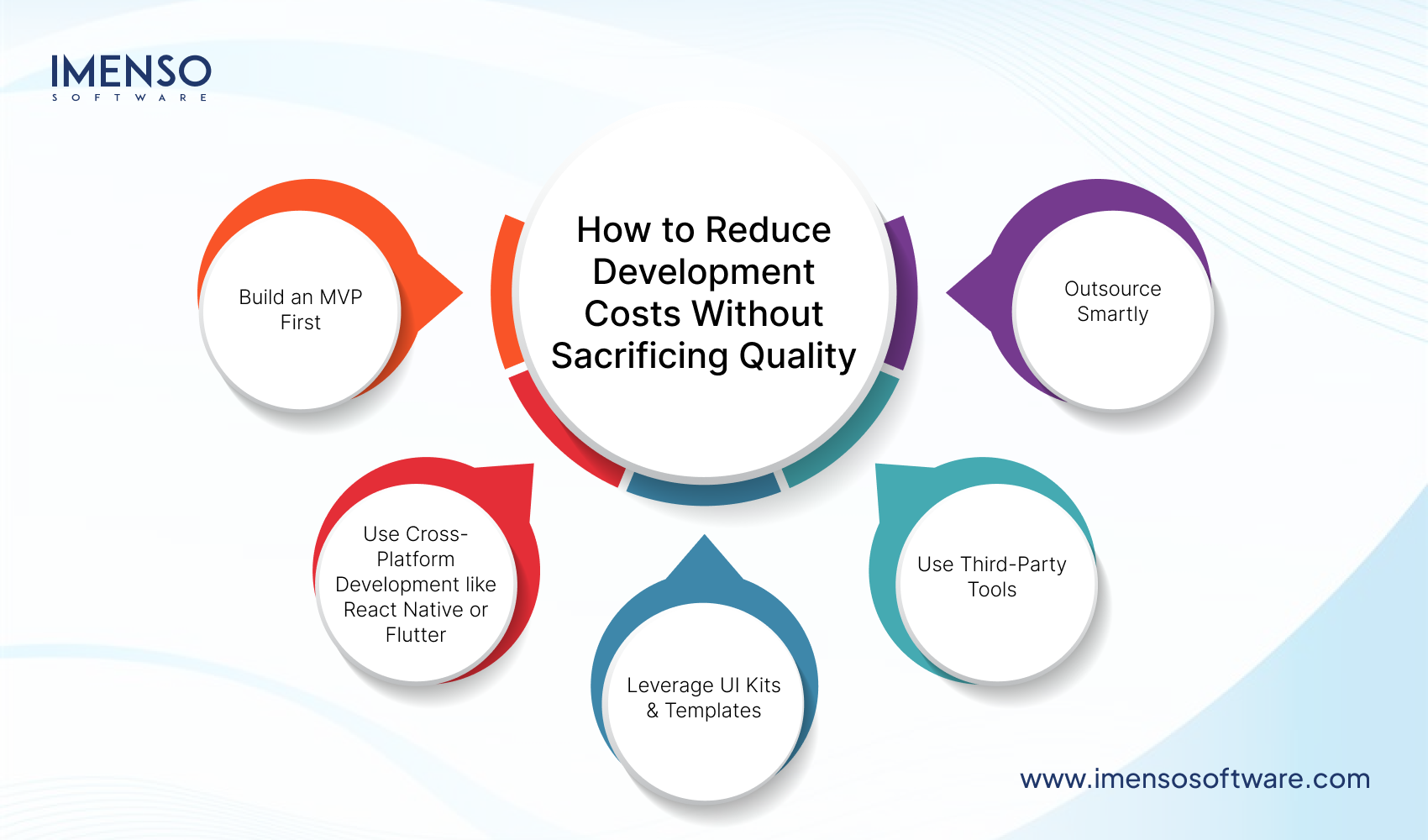
1. Build an MVP First
- Start with only the core features.
- Think login, catalog, cart, and checkout.
- Skip the extras like AI or loyalty rewards for v1.
- Test demand fast
- Save money on unused features
The saving would be approx. $20,000–$50,000+
2. Use Cross-Platform Development like React Native or Flutter
You get iOS and Android apps with one codebase. Faster to build and easier to maintain.
The saving would be approx. 30–40% on development cost.
3. Leverage UI Kits & Templates
Use proven UI libraries, like Shopify Polaris or Material Design, instead of designing everything from scratch.
- Saves time on wireframes
- Keeps design consistent across devices
4. Use Third-Party Tools
Instead of building every tool in-house, integrate with trusted APIs:
- Payments → Stripe
- Shipping → Shippo
- Chat → Intercom or Crisp
- Search → Algolia
This reduces dev hours and keeps you focused on your core product.
5. Outsource Smartly
Consider hiring vetted remote developers from Eastern Europe, Latin America, or India. Many startups cut costs by 50% or more with high-quality offshore talent.
Just be sure to:-
- Use contracts and NDAs
- Set clear timelines and milestones
- Work in agile sprints
Bonus Tip60% of app features go unused, so build only what your customers truly need and improve over time. Hence, you should avoid overbuilding. |
What’s the Real Cost to Build an E-Commerce App in 2025?
Building a successful e-commerce app isn’t just about writing code; it’s about creating a smooth, scalable shopping experience that your customers will love and return to. Whether you’re a solo founder, a growing DTC brand, or a large retail player, knowing the true cost helps you:
- Set realistic budgets.
- Avoid unexpected expenses.
- Prioritize features that drive conversions.
- Make smart decisions between native, PWA, or cross-platform.
Key Takeaways:
- Start lean with an MVP if you’re budget-conscious
- Use cross-platform tools like Flutter to save time and cost
- Don’t forget ongoing costs: QA, hosting, updates, and marketing
- Focus on core UX—fast load times, seamless checkout, and intuitive navigation
Remember, the best apps evolve, even Amazon started simple!
If you’re still unsure how to budget for your e-commerce app or want help finding the right team, tech stack, or tools, drop us a message. We help businesses turn big ideas into high-performing apps!
FAQs
Q1: What’s the average cost to build an e-commerce app?
A: A simple e-commerce MVP may cost $40,000–$70,000, while a mid-tier brand can expect to spend $80,000–$150,000. Enterprise-grade apps with advanced features like AI, AR, and headless architecture can exceed $250,000+.
Q2: How long does it take to develop an e-commerce app?
A: It varies from type of app as mentioned, and these timelines include design, development, testing, and deployment.
- MVP: 3–5 months
- Mid-range app: 5–8 months
- Enterprise app: 8–12+ months
Q3: Should I go with native, cross-platform, or a PWA?
A: Here’s how you can consider:
- Choose native for top-tier UX and full device integration.
- Choose cross-platform (Flutter/React Native) for faster, budget-friendly builds.
- Choose PWA for a simple, fast-to-launch MVP or content-heavy brand.
Q4: Is it cheaper to build or buy an app template?
A: Buying a pre-built template can save upfront costs, but it limits customization. Ideal for early testing, but scaling will likely require custom development later.
Q5: What hidden costs should I watch for?
A: Here is what you should not overlook.
- App store fees
- API subscriptions
- Post-launch maintenance
- Security compliance, such as PCI, ADA
- QA and device testing
- Cloud hosting and CDN services
Plan for at least 15–20% of the build cost, annually, for upkeep. Launch on the web first, then invest in mobile.